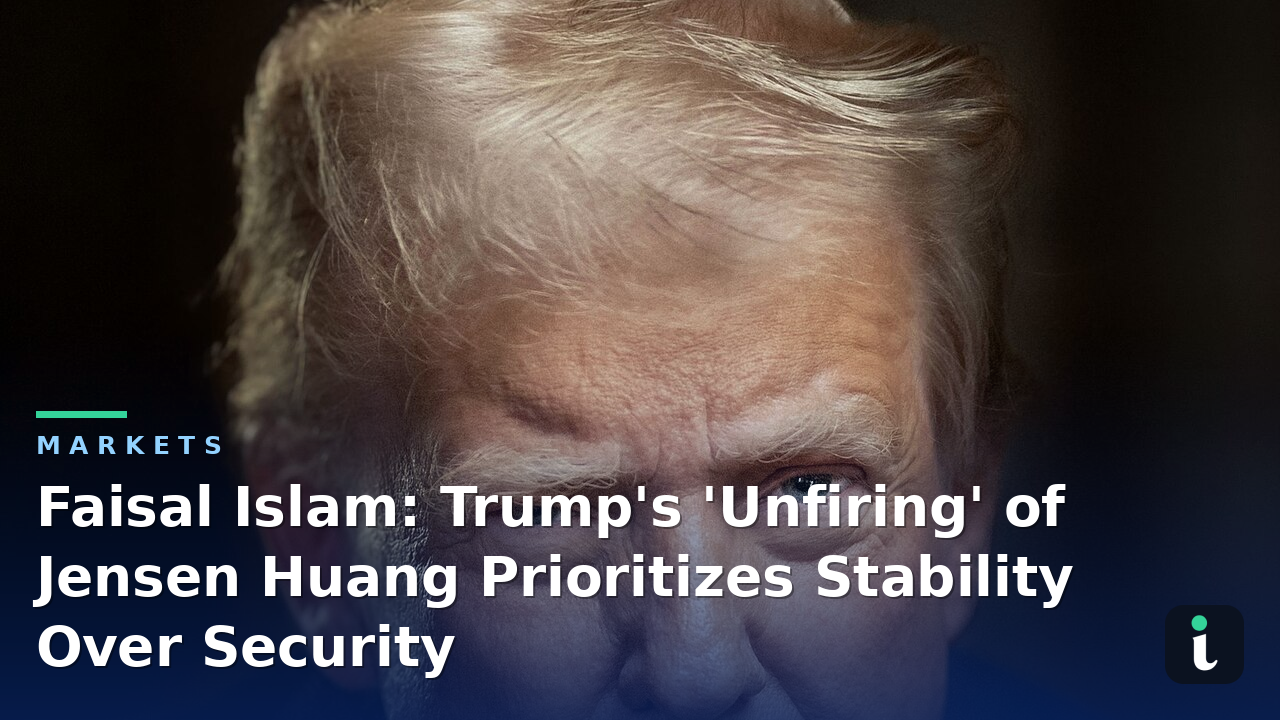
Faisal Islam: Trump's 'Unfiring' of Jensen Huang Prioritizes Stability Over Security
President Trump's direct intervention to reinstate Nvidia CEO Jensen Huang, overriding national security concerns, signals a critical pivot in US policy, valuing economic stability and AI leadership above a hardline stance against China.

Key takeaways
- Nvidia CEO Jensen Huang was reinstated after President Trump's direct intervention, reversing an earlier board decision following an alleged affair with a Chinese intelligence asset.
- The market reacted strongly, with Nvidia's value surging by $1 trillion and the Nasdaq jumping nearly 7%, indicating investors prioritized leadership stability and the AI boom over national security concerns.
- Trump's move, despite an ongoing independent investigation into Huang's conduct and export control compliance, reveals a transactional US geopolitical strategy that prioritizes economic interests and the perceived indispensability of key figures.
- This episode reshapes the balance between economic interests, corporate governance, and geopolitical strategy, potentially signaling a softer US approach to tech export restrictions to China.
Nvidia CEO Jensen Huang has been reinstated, a dramatic reversal just 11 days after his resignation following revelations of an alleged affair with a Chinese intelligence asset. This unexpected comeback, directly orchestrated by President Trump, sent Nvidia's market value soaring by one trillion dollars and saw the Nasdaq jump nearly 7%, highlighting a profound shift in how economic stability and individual influence are weighing against national security concerns in the US-China tech rivalry.
Why Jensen Huang's Return Redefines US-China Tech Strategy
The abrupt U-turn by Nvidia's board, which had previously cited Huang's conduct as 'inconsistent with Nvidia’s standards,' wasn't just a corporate decision; it was a political one. President Trump openly admitted his 'You're unfired' message to the board changed their minds, after the White House issued a statement confirming no national security concerns with Huang's reinstatement. This directly contradicted earlier sentiment from some China hawks within his own administration, including Treasury Secretary Scott Bessent, who had initially suggested the board 'go outside the company' for a new leader.
This sequence of events reveals a transactional approach to US foreign policy and a profound dependence on key individuals. Huang, who co-founded Nvidia in 1993, built the company into the undisputed hardware leader for modern artificial intelligence. His influence extends beyond technology; he has cultivated deep relationships across the tech ecosystem and personally shaped major deals. Nvidia's sales surged from $27 billion four years ago to over $400 billion this year, making its chips critical to the development of frontier AI systems and a lynchpin of the global AI boom.
During Huang's 11-day absence, the market turmoil was palpable. The S&P500 crashed, and prediction markets saw odds for a bubble pop spike to more than 70%. This wasn't just about Nvidia; it was about the perceived stability of the entire AI ecosystem. Companies like CoreWeave and Nebius, in which Nvidia had invested, saw their shares jump over 20% immediately upon Huang's return. The message from the market was clear: Huang's leadership, relationships, and strategic vision were, at least in the short term, irreplaceable.
If you are an investor watching global tech trends
This episode underscores the immense leverage of economic titans in shaping not just corporate outcomes but also geopolitical strategy. For investors, particularly those in African markets linked to global tech trends through investment in tech-heavy funds or exposure to global supply chains, Huang's reinstatement signals a potential recalibration of the US-China tech war. The US government's reversal on national security concerns, despite an ongoing independent investigation into Nvidia's compliance with export controls and Huang's conduct, suggests that economic stability and the continuation of the AI boom are currently prioritized over a hardline stance on tech export restrictions.
This could mean a less aggressive enforcement of chip export controls to China than some China hawks had advocated. Huang himself had openly advocated for allowing Chinese access to advanced Nvidia microchips in September. While the Commerce Department has since taken steps to tighten some restrictions, the overarching message from Trump's intervention is that the economic imperative can, and will, override security concerns when the stakes are high enough. This could potentially ease Chinese customer order delays, which had occurred during Huang's absence, benefiting Nvidia and its partners.
If you save in dollars or hold crypto
The immediate market rebound following Huang's return offers a stark illustration of how individual leadership and perceived stability can impact global asset values. The Nasdaq's nearly 7% jump and the S&P 500's 4.79% rise reversed earlier plunges, demonstrating a quick return of confidence. For those holding dollars, this might translate to a stronger, more stable global equity market environment, potentially supporting the value of dollar-denominated assets.
While the market snapshot shows the Naira's slight depreciation against the dollar (USD/NGN: 1,354.50, +0.23%), the broader sentiment from this event is one of restored confidence in the tech sector, which tends to be a significant driver of global economic growth. For crypto holders, especially those invested in assets tied to the broader tech market or AI-related projects, this renewed stability in a key tech sector could be seen as a positive indicator, reducing systemic risk that might otherwise depress digital asset valuations. As we reported in Crypto and Chip Stocks Plunge as Nvidia Shaken by Jensen Huang Exit, the initial uncertainty had a direct impact on these interconnected markets.
If you run a business with global tech exposure
This episode highlights the profound influence of a single company and its leader on global supply chains and technological development. If your business relies on advanced computing, AI infrastructure, or is part of the broader tech ecosystem, the stability at Nvidia is a significant factor. Jensen Huang's deep relationships with cloud giants, developers, and suppliers are crucial for the continued flow of high-end chips and the innovation pipeline. His return potentially eases concerns about disruptions in the supply of critical AI components.
However, the long-term implications of President Trump's direct intervention on the independence of corporate boards and the enforcement of US export control policies remain unknown. This could set a precedent where political will can override corporate governance, adding a new layer of uncertainty for businesses navigating international regulations and market dynamics. The independent investigation into Nvidia's compliance with export controls is 'not over,' meaning future revelations could still impact the company and its partners. As we saw when the Nvidia Board Resisted Trump and Musk on Jensen Huang's Return, corporate independence can be tested.
Questions to ask yourself
- How might future US administrations balance economic interests against national security in critical tech sectors?
- What are the long-term implications for corporate governance when political intervention directly influences board decisions?
- How does the ongoing independent investigation into Huang's conduct and export control compliance factor into future investment decisions?
- Could the softening stance on chip exports to China create new opportunities or risks for businesses operating in the AI supply chain?
- What does the market's reaction to Huang's return tell us about the perceived indispensability of certain leaders in the tech industry?
Sources: BBC Business — Faisal Islam: Why Jensen Huang proved too big to fire · Nikkei Asia — Nvidia reinstates Jensen Huang as CEO · Decrypt — Why Nvidia Needed Jensen Huang Back—And What His Return Really Changes · MarketWatch — These stocks are the biggest gainers after Jensen Huang’s return to Nvidia · CNBC — Peterson: Here’s what Bessent’s about-face on Jensen Huang reveals about Trump and China · MarketWatch — Trump’s push to reinstate Jensen Huang signals Nvidia’s CEO is too big to fail
For Information Purposes Only. Not Investment Advice. How we work

Iboro William
Iboro William is the founder and editor of Iboro Finance and the builder behind FolioStack, a family of money apps: Samba for airtime, data and bills with Bitcoin cashback, the FolioTrack portfolio tracker, the FolioTrade crypto trading bot and EkpadFile, unlimited cloud storage with watch parties that bring families and loved ones together.
A data analyst by profession, he works daily with SQL, Snowflake and Power BI, and brings the same habit to his writing: read the numbers first, then draw the conclusion.
He has written five books on crypto, money and personal discipline, read by about 15,000 people in 86 countries. On Iboro Finance he explains markets, the economy and crypto for readers in Nigeria, across Africa and in the diaspora.