Pablo Hernández de Cos Will Lead the ECB in a Push Against Dollar Stablecoins
The nomination of Pablo Hernández de Cos to lead the European Central Bank marks a victory for career technocracy and a pushback on dollar stablecoins.

Key takeaways
- Pablo Hernández de Cos is set to succeed Christine Lagarde as president of the European Central Bank next year.
- He has criticized US dollar-backed stablecoins for threatening monetary sovereignty.
- His leadership is part of a package deal balancing northern and southern eurozone political interests.
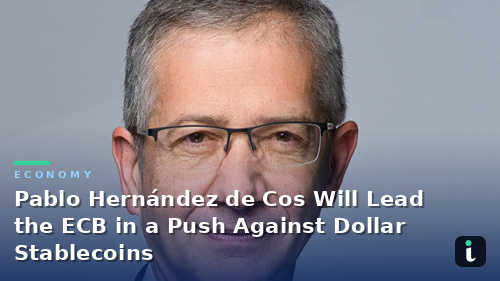
Pablo Hernández de Cos is set to succeed Christine Lagarde as president of the European Central Bank next year, following crucial backing from eurozone leaders at the European Council Summit. The 55-year-old career central banker and former governor of the Bank of Spain will take the helm on February 7, 2027, steering the institution through a delicate transition that also places Germany's Markus Brunnermeier as chief economist and France's Laurence Boone as head of the Markets Portfolio.
This leadership overhaul arrives as Europe grapples with stubborn price pressures, echoing themes we explored previously in Euro Zone Inflation Hits 4% as Energy Costs Surge and Rate Hikes Loom. Beyond traditional interest rate management, the incoming leadership brings a distinct philosophy on digital assets and monetary sovereignty that will ripple far beyond the continent.
Why is spain pablo taking over the European Central Bank?
Leaders across the eurozone agreed on de Cos to resolve intense political wrangling and establish a careful north-south balance within the central bank's executive board. Traditional northern powerhouses like Germany often lean hawkish, favoring strict rate hikes to control prices, while southern economies have recently enjoyed robust growth and stability. By appointing de Cos—a seasoned economist who formerly headed the Bank for International Settlements—the council selected a technocrat respected by both camps.
This compromise avoided a deadlock after the Netherlands backed rival candidate Klaas Knot before finally withdrawing support. Christian Kopf of Union Investment noted that de Cos brings the strongest technical understanding of monetary policy at a time when central bank independence faces global pressures. However, critics argue his past support for aggressive stimulus when inflation was low means he might be too lenient if core inflation remains elevated through 2029.
How will the new leadership regulate digital currencies and stablecoins?
De Cos is expected to adopt a much more skeptical regulatory posture toward privately issued digital assets, particularly US dollar-backed stablecoins. Speaking at Jackson Hole, he argued that stablecoins fail to provide a credible payment mechanism at scale and warned that their widespread adoption abroad could weaken domestic monetary transmission and drain commercial bank deposits.
Instead of private tokens, his presidency will likely accelerate public alternatives like the digital euro, for which a pilot is slated for 2027 ahead of a potential 2029 launch. This stance aligns with broader European efforts to establish clear digital asset frameworks, mirroring regional developments such as those seen with European Issuer AllUnity Launches US Dollar Stablecoin Amid MiCA Expansion. For global stablecoin issuers, this signals a hostile regulatory environment designed to protect the euro's dominance.
What does this mean for emerging markets and African economies?
Central bank policies in Frankfurt dictate global capital flows, borrowing costs, and currency valuations that impact emerging markets from Nigeria to South Africa. When major economies fortify their sovereign currencies against foreign stablecoins, it sets a regulatory benchmark for developing nations grappling with dollarization and volatile capital flight.
While African importers and savers managing US dollars must watch how harsher European rules influence global liquidity, local financial regulators monitor these central bank digital currency frameworks closely. As domestic authorities weigh aggressive measures like those seen in Nigeria's N2 Trillion Bond Offer Signals Aggressive Domestic Borrowing, advanced economy shifts in monetary technology provide a blueprint for state-backed digital currency adoption.
What happens next during the appointment process?
The formal appointment still requires consultation with the European Parliament and the ECB's Governing Council, although neither body holds a veto power over the council's consensus choice. Observers will monitor these proceedings for any unexpected pushback from lawmakers.
The crucial dates to watch include the official departure of Christine Lagarde on February 7, 2027, and the rollout of the digital euro pilot later that same year. Those milestones will test whether de Cos can successfully balance regional economic divergence while safeguarding Europe's monetary independence.
Sources: CNBC — Spain’s Pablo Hernández de Cos set to lead European Central Bank · Cointelegraph — BIS chief Pablo Hernández de Cos set to become next ECB president: FT
For Information Purposes Only. Not Investment Advice. How we work

Iboro William
Iboro William is the founder and editor of Iboro Finance and the builder behind FolioStack, a family of money apps: Samba for airtime, data and bills with Bitcoin cashback, the FolioTrack portfolio tracker, the FolioTrade crypto trading bot and EkpadFile, unlimited cloud storage with watch parties that bring families and loved ones together.
A data analyst by profession, he works daily with SQL, Snowflake and Power BI, and brings the same habit to his writing: read the numbers first, then draw the conclusion.
He has written five books on crypto, money and personal discipline, read by about 15,000 people in 86 countries. On Iboro Finance he explains markets, the economy and crypto for readers in Nigeria, across Africa and in the diaspora.